Learning a few Moroccan Arabic phrases can make everyday interactions in Morocco warmer, easier, and more respectful. Even basic expressions such as السلام عليكم — as-salamu alaykum, meaning “peace be upon you,” and شكرا بزاف — shukran bzaaf, meaning “thank you very much,” are important for greeting people politely and showing appreciation. Moroccan Arabic, also known as Darija, is the language of daily life in cafés, markets, taxis, homes, and medinas. Using it, even at a basic level, can help you connect with local people, navigate common travel situations, and approach Moroccan culture with greater confidence and awareness.
There is also an etiquette side to language. Morocco is a warm and welcoming country, but it is also a country with social codes. Greetings matter. The right hand is traditionally used for giving, receiving, eating, and greeting. Modesty is appreciated, especially in rural areas and near religious spaces. Public behaviour tends to be more formal than in many Western countries. When you combine basic Darija with cultural awareness, you are much less likely to feel lost, awkward, or accidentally rude.
This guide is built around real tourist needs in Morocco: greeting people, asking for help, finding your way, buying things, visiting cultural sites, taking photos respectfully, and handling everyday situations with confidence. Each section gives you useful Moroccan Arabic phrases in Arabic script, romanised Darija, English translation, and practical usage notes, so you know not only what to say, but when and how to say it.
→Sign Up Now: Free Trial Moroccan Arabic Lesson With a Native Teacher!←
Moroccan Arabic Greetings for Tourists in Morocco
Greetings in Morocco are not throwaway words. They are part of social life. When you enter a small shop, meet a driver, arrive at a riad, ask someone a question, or sit down in a café, beginning with a greeting is one of the simplest ways to show respect. Tourists who skip this step can sometimes seem impatient without meaning to. Tourists who start with “Salam” often find the whole exchange becomes warmer.
The most important greeting in Moroccan Arabic is السلام عليكم — As-salamu alaykum, meaning “peace be upon you.” You will also hear the shorter سلام — Salam — everywhere. The full version is more traditional and respectful; the shorter version is friendly and easy for daily use. The standard response is وعليكم السلام — Wa alaykum as-salam, meaning “and peace be upon you too.”
In Morocco, greetings may also involve a handshake, a hand placed over the heart, or cheek kisses between people who know each other well. As a tourist, especially when greeting someone of the opposite sex, it is best to wait and follow the other person’s cue. A smile and a hand over your heart is always polite and never intrusive.
Here are some useful Moroccan Arabic greetings for meeting people and handling everyday social interactions.
| English | Moroccan Arabic | Romanised Darija | Usage Notes |
| Hello / Peace be upon you | السلام عليكم | As-salamu alaykum | The most respectful general greeting. Use it when entering shops, homes, taxis, or meeting someone. |
| Hello | سلام | Salam | Short, friendly, and very common. Good for casual tourist situations. |
| And peace be upon you | وعليكم السلام | Wa alaykum as-salam | The correct response to As-salamu alaykum. |
| Welcome | مرحبا | Marhba | Used to welcome someone, but tourists can also use it warmly in conversation. |
| How are you? | لباس؟ | Labas? | One of the most useful Moroccan greetings. Literally suggests “all good?” or “no problems?” |
| Are you well? | كيداير؟ / كيدايرة؟ | Kidayr? / Kidayra? | Use kidayr? for a man and kidayra? for a woman. |
| I’m fine, thank God | لباس، الحمد لله | Labas, lhamdulillah | A natural answer to Labas? Very culturally appropriate. |
| What’s your name? | شنو سميتك؟ | Shno smiytek? | Useful when meeting a guide, host, driver, or new acquaintance. |
| My name is… | سميتي… | Smiyti… | Simple and friendly. Follow with your name. |
| Nice to meet you | متشرف / متشرفة | Mtsharref / Mtsharfa | Use mtsharref if you are male, mtsharfa if you are female. |
| Goodbye | بسلامة | Bslama | The standard everyday goodbye. Use it when leaving shops, taxis, cafés, or conversations. |
A good basic exchange in Moroccan Arabic might sound like this:
Salam. Labas?
Hello. How are you?
Labas, lhamdulillah. Shukran.
I’m fine, thank God. Thank you.
Even if your pronunciation is not perfect, the gesture matters. Say the words slowly, smile, and do not worry about sounding like a local. In Morocco, effort is often received as respect.
Moroccan Arabic Phrases for Asking for Help in Morocco
Every traveller eventually needs help. You may be looking for a bathroom, trying to understand a menu, confused in a medina, unsure about a bus, or simply unable to follow what someone has said. In Morocco, asking for help politely is usually well received, especially if you begin with a greeting and use عافاك — afak, meaning “please.”
Moroccan culture is highly hospitable, and many people are genuinely willing to help visitors. Still, tone matters. A direct English-style question can sometimes feel abrupt if it comes without greeting or politeness. A better approach is to start with Salam, then ask your question, then end with afak or shukran. This small structure makes your request feel respectful rather than demanding.
The word سمح ليا — smah lia — is especially useful. It can mean “excuse me” or “sorry,” and it softens almost any request. Use it before interrupting someone, asking for directions, moving through a crowded place, or apologising for a small mistake.
The following phrases can help you ask for assistance politely and explain common problems in Morocco.
| English | Moroccan Arabic | Romanised Darija | Usage Notes |
| Please | عافاك | Afak | One of the most important words for tourists. Use it often. |
| Thank you | شكرا | Shukran | Understood everywhere. You may also hear merci in Morocco. |
| Excuse me / Sorry | سمح ليا | Smah lia | Use before asking for help or when you need to apologise. |
| Can you help me? | واش تقدر تعاوني؟ | Wash tqder taawenni | Use when speaking to a man. |
| Can you help me? | واش تقدري تعاونيني؟ | Wash tqdri taawenini? | Use when speaking to a woman. |
| Help me, please | عاوني عافاك | Aawenni afak | More direct. Useful in urgent but non-emergency situations. |
| I don’t understand | ما فهمتش | Ma fhemtsh | Essential phrase. Use it whenever someone speaks too fast. |
| I don’t speak Arabic | ما كنهضرش العربية | Ma kanhdersh l-arbia | Useful when you need someone to slow down or switch language. |
| Speak slowly, please | هضر بشوية عافاك | Hder bshwiya afak | Very useful in shops, taxis, and guided visits. |
| What did you say? | شنو قلتي؟ | Shno glti? | Informal but common. Use gently, with a polite tone. |
| I have a problem | عندي مشكل | Aandi mushkil | Useful at hotels, stations, or with transport. |
| I am lost | تجليت | Tjlit | Useful in medinas, where getting lost is almost part of the experience. |
| Where is the bathroom? | فين كاينة الطواليت؟ | Fin kayna twalit? | Practical and important. Twalit comes from French “toilette.” |
| I need a doctor | محتاج طبيب | Mhtaj tbib | Use in medical situations. |
| Call the police | عيط للبوليس | Ayet lbolis | For serious emergencies only. |
A respectful help request might look like this:
Salam, smah lia. Fin kayna twalit, afak?
Hello, excuse me. Where is the bathroom, please?
Or:
Smah lia, ma fhemtsh. Hder bshwiya, afak.
Sorry, I didn’t understand. Speak slowly, please.
In a Moroccan medina, people may offer help before you ask for it. Many will be kind and genuine; some may expect a tip, especially in heavily touristed areas. If you do not want help, it is fine to smile and say la, shukran — “no, thank you.” Politeness does not mean you have to accept every offer.
Phrases for Directions and Getting Around Morocco
Getting around Morocco is part of the adventure. Cities like Marrakech, Fes, Tangier, Rabat, and Casablanca all have their own rhythm, and the older medinas can feel like living mazes. Streets twist, signs are not always obvious, and GPS may not understand narrow alleys, souks (traditional Moroccan open-air marketplaces), or small passageways. That is why a few Darija phrases for directions can be more useful than any app.
The most important word here is فين — fin, meaning “where.” Once you know fin, you can ask for almost anything: the hotel, the taxi, the market, the bus station, the bathroom, the restaurant, or the medina. You do not need perfect grammar to be understood. In many real situations, a simple phrase like Fin taxi? can work.
When asking for directions, remember the cultural pattern: greet first, ask politely, and thank the person. If someone walks you part of the way, that can be an act of hospitality, but in tourist-heavy areas it may also come with an expectation of money. Keep small coins or small dirham notes with you, and trust your instincts.
Here are a few practical phrases for asking directions, using transport, and finding important places in Morocco.
| English | Moroccan Arabic | Romanised Darija | Usage Notes |
| Where is…? | فين كاين…؟ | Fin kayn…? | Use for masculine nouns or general places. |
| Where is…? | فين كاينة…؟ | Fin kayna…? | Use for feminine nouns, but tourists do not need to worry too much. You will still be understood. |
| Where is the hotel? | فين كاين الأوطيل؟ | Fin kayn l-otel? | Otel comes from French and is widely understood. |
| Where is the riad? | فين كاين الرياض؟ | Fin kayn r-riad? | Useful in medinas, where riads can be hidden in small alleys. |
| Where is the taxi? | فين كاين الطاكسي؟ | Fin kayn taxi? | Practical in cities and at transport points. |
| Where is the bus? | فين كاين الطوبيس؟ | Fin kayn tobis? | Tobis means bus. |
| Where is the train station? | فين كاينة لاگار؟ | Fin kayna la gare? | La gare comes from French and means train station. |
| Where is the market? | فين كاين السوق؟ | Fin kayn souq? | Useful for traditional markets and souks. |
| Where is the medina? | فين كاينة المدينة؟ | Fin kayna l-mdina? | The medina is the old city. |
| I want to go to… | بغيت نمشي ل… | Bghit nmshi l… | Useful for taxis and asking directions. |
| Is it near? | واش قريب؟ | Wash qrib? | Use when deciding whether to walk. |
| Is it far? | واش بعيد؟ | Wash b’id? | Useful before accepting directions or a taxi ride. |
| Left | اليسر | Liser | Useful when receiving directions. |
| Right | اليمن | Limen | Useful when receiving directions. |
| Straight ahead | نيشان | Nishan | Very common direction word. |
| Stop here, please | وقف هنا عافاك | Wqef hna afak | Useful in taxis or when walking with a guide. |
| I don’t know the way | ما عرفت الطريق | Ma areft triq | Useful if you are lost or unsure. |
| Can you show me on the map? | واش تقدر توريني فالخريطة؟ | Wash tqder twerrini f l-kharita? | Useful when you have your phone or paper map open. |
A simple direction exchange in Morocco could be:
Salam, smah lia. Fin kayn l-otel, afak?
Hello, excuse me. Where is the hotel, please?
Wash qrib?
Is it near?
Shukran bzzaf.
Thank you very much.
The phrase shukran bzzaf is a lovely one to remember. It means “thank you very much,” and it often sounds warmer than a quick “thanks.” Morocco is a country where people take time with social exchanges. Even when you are only asking for directions, a little warmth can turn a practical question into a human moment.
Darija Phrases for Buying Souvenirs in Moroccan Souks
Buying souvenirs in a Moroccan souk is a social experience. The objects matter, of course: carpets, ceramics, lanterns, leather bags, spices, jewellery, babouches, scarves, woodwork, and hand-painted bowls all carry the look and feel of Moroccan craft. But the way you buy them matters too. In many souks, the exchange begins with greeting, looking, asking, talking, joking, and only then discussing the price.
Start with Salam when you enter a shop or stall. This matters more than many tourists realise. A greeting shows that you see the seller as a person, not simply as someone behind a price tag. If you want to browse, say so politely. If you are interested in something, ask about it with curiosity. Many Moroccan sellers are proud of their goods and may tell you where something was made, what material it uses, or which region the design comes from.
Touch items carefully, especially fragile ceramics, glass, metalwork, and textiles. If you unfold scarves or carpets, allow the seller to help you. Do not treat the shop like a self-service store unless the atmosphere clearly suggests it. In traditional souks, personal interaction is part of the shopping process.
These Moroccan Arabic phrases will help you browse, ask about products, and buy souvenirs in a souk.
| English | Moroccan Arabic | Tourist Pronunciation | Usage Notes |
| Hello | سلام | salam | Always a good way to begin when entering a shop. |
| I’m just looking | غير كنشوف | ghir kan-shoof | Useful if you want to browse without committing. Say it with a smile. |
| What is this? | شنو هادا؟ | shno hada? | Use when asking about an object. |
| Is this handmade? | واش هادا مصنوع باليد؟ | wash hada mas-noo b-l-yed? | Useful for crafts, carpets, leather goods, and ceramics. |
| Where is this from? | منين هادا؟ | mneen hada? | A good phrase if you are interested in regional craft. |
| I like this | عجبني هادا | ajabni hada | Shows interest without immediately agreeing to buy. |
| Do you have another colour? | واش عندك لون آخر؟ | wash andek lon akhor? | Useful for scarves, clothing, bags, ceramics, and textiles. |
| Do you have a smaller one? | واش عندك واحد صغر؟ | wash andek wahed sghar? | Useful for souvenirs when luggage space matters. |
| Do you have a bigger one? | واش عندك واحد كبر؟ | wash andek wahed kbar? | Useful for carpets, lamps, or decorative pieces. |
| How much is this? | بشحال هادا؟ | bsh-hal hada? | The key souvenir-shopping phrase. |
| I’ll take this | غادي ناخد هادا | ghadi nakhod hada | Use only when you are ready to buy. |
| Can you wrap it, please? | واش تقدر تغلفو عافاك؟ | wash tqder tghalfo afak? | Useful for fragile items. |
| Thank you very much | شكرا بزاف | shukran bzaaf | A warm way to end the exchange. |
A natural exchange might sound like this in Moroccan Arabic:
Salam. Shno hada?
Hello. What is this?
Wash hada mas-noo b-l-yed?
Is this handmade?
Bsh-hal hada?
How much is this?
The biggest etiquette point is this: do not begin with suspicion. Many tourists enter souks already expecting to be cheated, and that energy can make the exchange tense from the start. It is better to be friendly, alert, and calm. Ask questions, compare prices, and bargain when appropriate, but keep the tone human. A good souk interaction can be one of the most memorable parts of travelling in Morocco.
Moroccan Arabic Phrases for Shopping for Clothes in Morocco
Shopping for clothes in Morocco can mean very different things depending on where you are. In a modern mall in Casablanca, Rabat, or Marrakech, the experience may feel familiar: fixed prices, changing rooms, card payments, and standard sizes. In a medina or traditional market, the interaction is often more personal. You may be looking at handmade leather slippers, embroidered tunics, djellabas, scarves, kaftans, belts, or locally made fabrics, and the seller may guide you through colours, sizes, cuts, and materials.
Clothing also connects directly to Moroccan etiquette. Morocco has large cities with modern fashion, beach towns with a more relaxed atmosphere, and rural or religious settings where modest dress is appreciated. As a tourist, it is practical and respectful to have clothes that cover shoulders and knees, especially in medinas, villages, family homes, and near sacred places. Lightweight trousers, long skirts, loose shirts, linen layers, and scarves are useful because they suit both the climate and the cultural setting.
When trying clothes on, ask first. In some shops, there will be a changing room; in smaller stalls, there may not be one. If you are buying traditional clothing, let the seller explain how it is worn. A djellaba, scarf, or kaftan may carry regional or cultural associations, and asking about them respectfully often leads to a richer conversation.
The phrases below are useful for asking about sizes, colours, prices, and changing rooms in Morocco.
| English | Moroccan Arabic | Tourist Pronunciation | Usage Notes |
| I’m looking for clothes | كنقلب على حوايج | kan-qalleb ala hwayj | General phrase for clothes shopping. |
| Do you have this in my size? | واش عندك هادا فالقياس ديالي؟ | wash andek hada f l-qiyas dyali? | Useful in shops and markets. |
| Do you have a larger size? | واش عندك قياس كبر؟ | wash andek qiyas kbar? | Useful for trousers, shirts, dresses, and jackets. |
| Do you have a smaller size? | واش عندك قياس صغر؟ | wash andek qiyas sghar? | Useful when something is too loose. |
| Can I try it on? | واش نقدر نجربو؟ | wash nqder njarbo? | Ask before trying on clothes. |
| Where is the changing room? | فين كاينة البلاصة ديال التبدال؟ | fin kayna blasa dyal tbdal? | Useful in larger shops. |
| It’s too big | كبير بزاف | kbeer bzaaf | Simple and useful. |
| It’s too small | صغير بزاف | sghir bzaaf | Simple and useful. |
| It fits well | جا مزيان | ja mez-yan | Use when something fits nicely. |
| I like this colour | عجبني هاد اللون | ajabni had lon | Useful for scarves, dresses, shirts, and fabrics. |
| Do you have another colour? | واش عندك لون آخر؟ | wash andek lon akhor? | Good for comparing options. |
| How much is this? | بشحال هادا؟ | bsh-hal hada? | Essential in markets and small shops. |
| I’ll think about it | نفكر شوية | nfakker shwiya | A polite way to delay the decision. |
| I’ll take it | غادي ناخدو | ghadi nakhdo | Use when you are ready to buy. |
A simple clothes-shopping exchange in Morocco might be:
Salam. Wash nqder njarbo?
Hello. Can I try it on?
Wash andek qiyas kbar?
Do you have a larger size?
Ja mez-yan. Bsh-hal hada?
It fits well. How much is this?
If you are shopping for Moroccan-style clothes, avoid treating them as costumes. A kaftan, djellaba, scarf, or pair of babouches may be beautiful and photogenic, but they are also part of living culture. Ask how something is worn, when people wear it, and whether it is everyday, formal, regional, or ceremonial. That kind of curiosity shows respect and usually makes the shopping experience more interesting.
Darija Phrases for Bargaining in Morocco Without Being Rude
Bargaining in Morocco is common in souks, craft shops, and some informal markets. It is expected in many traditional shopping situations, especially for souvenirs, leather goods, carpets, lamps, textiles, and decorative objects. The key is to understand bargaining as a social exchange. It works best when both people can enjoy the conversation and leave with dignity.
Good bargaining starts before the price. Greet the seller, look carefully, ask about the item, and show interest without appearing desperate. Once you ask the price, the negotiation begins. If the first price feels high, you can smile and say that it is expensive. From there, offer a lower price politely. The tone should be calm, playful, and respectful.
The most important rule is to avoid bargaining aggressively over tiny amounts. A few dirhams may mean very little to a tourist and much more to a local seller. It is fine to negotiate, but it is rude to humiliate someone, mock the price, insult the product, or act as if every seller is trying to cheat you. It is also rude to agree on a price and then walk away.
Here are some polite Moroccan Arabic phrases you can use to discuss prices and negotiate without sounding aggressive.
| English | Moroccan Arabic | Tourist Pronunciation | Usage Notes |
| How much is this? | بشحال هادا؟ | bsh-hal hada? | The basic phrase that begins the price discussion. |
| That’s expensive | غالي بزاف | ghali bzaaf | Say it with a smile, not with anger. |
| Can you lower the price? | واش ممكن تنقص شوية؟ | wash mumkin tnqes shwiya? | Polite and useful when bargaining. |
| Give me a good price | عطيني تمن مزيان | ateeni taman mez-yan | Friendly phrase if said warmly. |
| I saw it cheaper | شفتو رخيص | shefto rkhis | Use carefully. Do not use it as an insult. |
| What is your final price? | شحال آخر تمن؟ | sh-hal akher taman? | Useful when you want to settle the negotiation. |
| My budget is… | الميزانية ديالي هي… | l-mizaniya dyali hiya… | Useful for larger items like carpets. |
| I can pay… | نقدر نخلص… | nqder nkhalles… | Use when making a counter-offer. |
| That works for me | واخا | wakha | Means okay/agreed. |
| I’ll take it | غادي ناخدو | ghadi nakhdo | Use when you accept the price. |
| No, thank you | لا، شكرا | la, shukran | Polite refusal if you are leaving. |
| Maybe later | يمكن من بعد | yimken men baad | Useful if you want to leave without sounding harsh. |
A respectful bargaining exchange might sound like this:
Bsh-hal hada?
How much is this?
Ghali bzaaf. Wash mumkin tnqes shwiya?
That’s very expensive. Can you lower the price a little?
Wakha. Ghadi nakhdo. Shukran bzaaf.
Okay. I’ll take it. Thank you very much.
There is a difference between bargaining and fighting. Bargaining in Morocco often includes humour, patience, and performance. You can smile, hesitate, compare, and counter-offer. You can also walk away politely if the price does not work for you. A friendly la, shukran is better than a dramatic exit.
Fixed-price shops are different. If a shop clearly has price tags or says prix fixe, bargaining may not be appropriate. In boutiques, malls, pharmacies, supermarkets, and many modern stores, the listed price is the price. Knowing where bargaining belongs is part of shopping respectfully in Morocco.
Moroccan Arabic Phrases for Visiting Mosques and Sacred Places in Morocco
Morocco has some of the most beautiful religious architecture in North Africa: mosques, minarets, zawiyas, shrines, old city gates, Qur’anic schools, and historic religious complexes. These places are central to Moroccan identity, spirituality, and daily life. For tourists, they require extra care.
Most mosques in Morocco are closed to non-Muslim visitors. The Hassan II Mosque in Casablanca is the famous exception and offers guided visits at specific times. In other places, tourists may admire the architecture from outside, look through open doors from a respectful distance, and take in the soundscape of the call to prayer without entering. Trying to step inside a mosque “just for a quick look” can cause serious offence.
Sacred places also include shrines, tombs of saints, religious schools, cemeteries, and prayer areas. Some may appear quiet or open from the outside, but that does not mean tourists are free to enter. When in doubt, ask. A licensed guide or local host can tell you what is appropriate.
The following phrases can help you ask permission and follow local rules when visiting religious and sacred places in Morocco.
| English | Moroccan Arabic | Tourist Pronunciation | Usage Notes |
| Is it possible to enter? | واش ممكن ندخل؟ | wash mumkin ndekhel? | Ask before entering any religious or sacred space. |
| Is this place open to visitors? | واش هاد البلاصة محلولة للزوار؟ | wash had blasa mahlula l-zowwar? | Useful at historic religious sites. |
| I am not Muslim | أنا ماشي مسلم / مسلمة | ana mashi muslim / muslima | Use muslim if you are male, muslima if you are female. |
| Can I take a photo? | واش ممكن ناخد تصويرة؟ | wash mumkin nakhod tswira? | Ask before photographing sacred spaces, guards, or people. |
| Should I remove my shoes? | واش خاصني نحيد الصباط؟ | wash khasni nheed s-sbat? | Useful before entering traditional or religious interiors. |
| Should I cover my head? | واش خاصني نغطي راسي؟ | wash khasni nghatti rasi? | Useful for women in certain sacred or traditional contexts. |
| Where is the entrance? | فين كاين المدخل؟ | fin kayn l-madkhal? | Use only after confirming visitors are allowed. |
| Where can visitors go? | فين يقدرو يمشيو الزوار؟ | fin yqdro yimshiw z-zowwar? | Useful in guided religious or historic sites. |
| Thank you for explaining | شكرا على الشرح | shukran ala sh-sharh | A polite phrase for guides or staff. |
| I understand | فهمت | fhem-t | Useful after receiving a rule or explanation. |
A respectful exchange might be:
Salam. Wash mumkin ndekhel?
Hello. Is it possible to enter?
Ana mashi muslim. Fin yqdro yimshiw z-zowwar?
I am not Muslim. Where can visitors go?
Shukran ala sh-sharh.
Thank you for explaining.
Dress matters near sacred places. Cover shoulders and knees, avoid sheer clothing, and keep beachwear for the beach. Women may find a light scarf useful, even when it is not strictly required. Men should avoid sleeveless tops and very short shorts in religious or traditional settings.
Speak quietly near mosques, especially during prayer times. Avoid standing directly in front of people who are praying, stepping over prayer mats, blocking entrances, or taking close-up photos of worshippers. The call to prayer is a living religious practice, not a performance for tourists. Stop, listen respectfully, and allow the moment to belong to the people who are praying.
Darija Phrases for Taking Photos Respectfully in Morocco
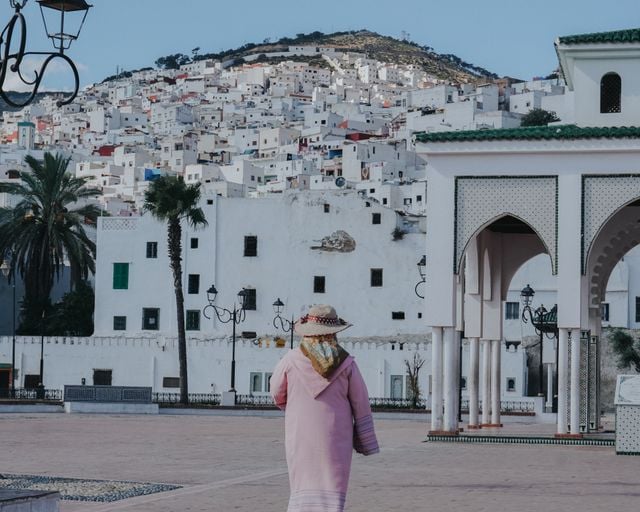
Morocco is intensely photogenic: blue streets, carved doors, spice pyramids, tilework, desert light, mountain villages, colourful textiles, and busy medinas. Photography is one of the great pleasures of travelling there. It is also one of the easiest ways to offend someone if you forget that beautiful scenes often include real people going about their day.
The main rule is simple: ask before photographing people. This is especially important with women, older people, children, artisans at work, and anyone in a private or religious setting. Some people may say yes. Some may say no. Some may ask for a small tip, especially in tourist areas or when posing is part of their livelihood. All three responses deserve respect.
Do not sneak photos. A hidden camera or quick zoom can feel invasive. If someone turns away, covers their face, waves their hand, or looks uncomfortable, lower the camera immediately. A missed photo is better than a disrespectful one.
Use these phrases to request permission before photographing people, shops, or culturally sensitive places in Morocco.
| English | Moroccan Arabic | Tourist Pronunciation | Usage Notes |
| Can I take a photo? | واش ممكن ناخد تصويرة؟ | wash mumkin nakhod tswira? | The most important photography phrase. |
| Is a photo possible? | ممكن تصويرة؟ | mumkin tswira? | Short, friendly, and easy to remember. |
| Can I photograph this? | واش ممكن نصور هادا؟ | wash mumkin nsawwer hada? | Use for objects, stalls, buildings, or displays. |
| Can I photograph the shop? | واش ممكن نصور الحانوت؟ | wash mumkin nsawwer l-hanoot? | Useful in souks and craft shops. |
| Can I photograph you? | واش ممكن نصورك؟ | wash mumkin nsawrek? | Ask directly and kindly. |
| No problem | ماشي مشكل | mashi mushkil | Useful if someone refuses and you want to show you accept it. |
| I understand | فهمت | fhem-t | Polite after someone explains a restriction. |
| Thank you | شكرا | shukran | Use whether the person says yes or no. |
| Beautiful | زوين / زوينة | zween / zwee-na | Use zween for masculine things, zwee-na for feminine things. A kind compliment, but do not overdo it. |
| May I give you something? | واش نعطيك شي حاجة؟ | wash nteek shi haja? | Useful if someone poses or expects a small tip. |
| Sorry | سمح ليا | smah lia | Use immediately if you accidentally photograph someone. |
A respectful photo request in Morocco might sound like this:
Salam. Mumkin tswira?
Hello. Is a photo possible?
If the person agrees:
Shukran bzaaf. Zween.
Thank you very much. Beautiful.
If the person refuses:
Mashi mushkil. Shukran.
No problem. Thank you.
Photography etiquette also applies to places. Avoid photographing police, soldiers, military buildings, government facilities, and security checkpoints. Be careful around royal palaces and official buildings. In sacred spaces, ask before taking photos, avoid flash, and never photograph people in prayer without permission.
The best travel photos usually come from connection. Buy something, talk for a moment, ask about the craft, compliment the work, and then ask for a photo. When people feel respected, the image has a different quality. It records a brief relationship, not a stolen moment.
Learn Moroccan Arabic Before You Travel to Morocco
Learning Moroccan Arabic before travelling gives you a more confident, more personal experience of Morocco. Even a short course can help you greet people naturally, ask for directions, handle souk conversations, understand basic prices, speak to drivers, and show respect in homes, markets, restaurants, and cultural sites.
Moroccan Arabic is best learned through real conversation. Phrase lists are useful, but they cannot always teach you tone, rhythm, pronunciation, gesture, or when a phrase sounds too formal, too direct, or too casual. Moroccan Arabic is a spoken language of everyday life, so learners benefit from hearing it, repeating it, and practising it in realistic travel situations.
That is where personalised Moroccan Arabic lessons make a real difference. With Language Trainers, you can learn Moroccan Arabic with a native-speaking teacher who adapts the course to your trip, your level, and your goals. If you are travelling to Marrakech, Fes, Casablanca, Tangier, Chefchaouen, the Atlas Mountains, or the Sahara, your lessons can focus on the exact situations you are likely to face: greetings, taxis, hotels, souks, restaurants, photography etiquette, bargaining, emergencies, and polite refusals.
Face-to-face lessons are especially helpful for Moroccan Arabic because pronunciation and body language matter. A teacher can show you how to soften a request, how to say la, shukran without sounding rude, how to pronounce difficult sounds more naturally, and how to recognise common phrases when Moroccans speak quickly. You also receive immediate correction, which is difficult to get from apps or phrasebooks.
Online lessons work equally well for learners who need flexibility or want to prepare before departure. Instead of memorising random phrases, you can follow a practical progression through greetings and politeness, directions and transport, shopping and food, and cultural situations such as visiting a home, entering sacred spaces, or travelling during Ramadan.
Charlotte Merle, who completed a 35-hour online course from Brisbane, appreciated both the quality and flexibility of this approach:
“I am so happy with my lessons with Laila. The teacher is very kind and patient and the materiel is good. She is flexible enough in terms of schedule and always on time.”
A personalised Moroccan Arabic course can help you:
- practise the phrases you will actually use while travelling;
- understand when Moroccan Arabic, French, or English is most useful;
- improve your pronunciation before speaking with locals;
- learn cultural etiquette alongside the language;
- prepare for interactions in souks, taxis, riads, and restaurants;
- feel more relaxed when asking for help or saying no politely.
The aim is to travel with better language skills, greater cultural awareness, and more confidence. Arriving with some Moroccan Arabic prepares you to greet people, thank them, make polite requests, understand more of what you hear, and move through Morocco respectfully.
Whether you need a short survival course before your holiday or a deeper introduction to Moroccan Arabic, Language Trainers can tailor your lessons to your itinerary, schedule, and learning style. With the support of a real teacher, you can move beyond memorised words and use Moroccan Arabic in the situations that make travelling in Morocco richer, warmer, and easier. Contact Language Trainers today and get a free trial Moroccan Arabic lesson!
→Sign Up Now: Free Trial Moroccan Arabic Lesson With a Native Teacher!←
4 Questions About Using Darija Respectfully in Morocco
1. How do you say no respectfully in Morocco?
The simplest polite refusal is لا، شكرا — la, shukran, meaning “no, thank you.” Say it calmly and with a smile. In markets or when declining an offer, you can also say يمكن من بعد — yimken men baad, meaning “maybe later,” although a clear la, shukran is better when you are not interested.
2. What are the best Darija phrases when visiting someone’s home in Morocco?
Begin with السلام عليكم — as-salamu alaykum and thank your host with شكرا بزاف — shukran bzaaf, meaning “thank you very much.” You can compliment the home by saying الدار زوينة — d-dar zwina, meaning “the house is beautiful,” and praise the food with بنين بزاف — bnin bzaaf, meaning “very delicious.” Follow your host’s lead regarding shoes, seating, and eating, and use your right hand when accepting food or drinks.
3. What basic Moroccan Arabic greetings should tourists learn?
The most useful greeting is السلام عليكم — as-salamu alaykum, with the response وعليكم السلام — wa alaykum as-salam. You can also use the shorter سلام — salam, ask لباس؟ — labas? meaning “how are you?”, and say goodbye with بسلامة — bslama. Greeting people before asking a question or entering a shop is an important sign of respect in Morocco.
4. What Darija phrases are most useful when shopping in Morocco?
Start with سلام — salam, then ask بشحال هادا؟ — bsh-hal hada?, meaning “how much is this?” To negotiate politely, say واش ممكن تنقص شوية؟ — wash mumkin tnqes shwiya?, meaning “can you lower the price a little?” When you agree, say واخا — wakha, meaning “okay,” or decline with لا، شكرا — la, shukran.