Travelling or living in France usually means thinking about cafés, museums, work, study, or simply getting used to everyday life in a new country. Medical vocabulary is probably not the first thing you plan to learn. But if you develop a fever, hurt yourself, need a prescription, or suddenly have to explain a symptom to a doctor, a few well-chosen French phrases can become extremely useful.
Knowing basic French medical vocabulary can help you explain where something hurts, answer routine questions, understand instructions, and ask for what you need at a pharmacy. This guide covers practical language for doctor’s appointments, hospitals, pharmacies, and medical emergencies in France, while also explaining some of the healthcare terms visitors and expats are likely to encounter.
Educational disclaimer: This article is intended as a language-learning resource only. Language Trainers teaches French and does not provide medical care, diagnosis, treatment, or emergency support. For urgent or serious health problems, contact a qualified healthcare professional and use professional interpretation services where necessary. The information below is not a substitute for medical advice.
→Sign Up Now: Free Trial French Lesson With a Native Teacher!←
What Should Visitors and Expats Know About Healthcare in France?
France has a large public health insurance system, but healthcare itself is delivered through a combination of public hospitals, private clinics, independent doctors, specialists, and pharmacies. That distinction matters because “public healthcare” in France does not necessarily mean that every appointment or treatment is automatically free at the point of use.
People who work or reside in France on a stable and regular basis may qualify for coverage through Assurance Maladie, the French national health insurance system. Under Protection universelle maladie, usually shortened to PUMa, eligible residents can have healthcare costs covered according to French reimbursement rules. Foreign employees working in France are generally affiliated with the French social security system, while eligibility for people who are not working depends on their residence and individual circumstances.
Visitors are in a different position. Travellers from the EU, EEA, Switzerland, or the UK may be able to use a valid European Health Insurance Card or equivalent documentation for medically necessary treatment during a temporary stay, subject to the applicable rules. Other visitors should check their travel or private insurance before arriving, since they may need to pay healthcare costs themselves and seek reimbursement from their insurer afterwards.
Assurance Maladie, Carte Vitale, and Mutuelle: What Do These Terms Mean in France?
If you spend any length of time in France, you will quickly encounter three terms that are easy to confuse: Assurance Maladie, Carte Vitale, and mutuelle.
Assurance Maladie is the national health insurance system that reimburses eligible healthcare expenses. People who work in France, as well as those who meet the conditions for stable and regular residence, can qualify for coverage under the French system.
A Carte Vitale is the health insurance card used by people registered with Assurance Maladie. It allows healthcare professionals to transmit reimbursement information electronically. It is therefore not an insurance policy in itself: it is evidence of your registration with the French health insurance system and helps simplify reimbursement.
A mutuelle is complementary health insurance. French statutory insurance does not necessarily reimburse the full cost of every consultation, prescription, test, or hospital stay, so many residents use a mutuelle to cover some or all of the remaining amount.
For newcomers, these terms are worth learning as vocabulary as well as understanding administratively. A receptionist might ask Vous avez votre carte Vitale ? [Do you have your Carte Vitale?], while a clinic may ask whether you have a mutuelle or other complementary insurance.
Public Hospitals, Private Clinics, and Doctors in France
France has both public hospitals and private healthcare establishments, and patients may receive reimbursable care in either depending on the provider and circumstances. Outside emergency situations, people covered by Assurance Maladie can generally choose where they receive hospital treatment, whether in a public or private establishment.
For routine health problems, however, your first contact is often not a hospital. Many patients see a médecin généraliste [general practitioner / GP] in a medical practice or health centre. Residents who are part of the French insurance system are also encouraged to nominate a médecin traitant, essentially their usual or coordinating doctor, who helps manage referrals and ongoing care.
Specialists are called médecins spécialistes. Depending on the problem, you might be referred to a dermatologue [dermatologist], cardiologue [cardiologist], gynécologue [gynaecologist], or another specialist.
In an emergency, you can go to les urgences [the emergency department]. France also has both public and private emergency facilities, although availability and waiting times vary considerably by location and severity.
What Visitors Should Bring to a Medical Appointment in France
If you need medical care while visiting France, bring whatever documentation makes identification, insurance, and payment easier. That will usually include your passport or ID, details of your travel insurance, and, where applicable, your European Health Insurance Card.
It is also useful to carry a list of medications you take regularly, allergies, relevant health conditions, and the generic names of any medicines you use. Brand names differ between countries, so a French doctor or pharmacist may recognise the active ingredient more readily than the product name you normally use at home.
If you live in France and are registered with Assurance Maladie, bring your Carte Vitale. Depending on the situation, you may also be asked for your carte de mutuelle [complementary insurance card].
Even insured patients sometimes have to pay part or all of a healthcare bill before reimbursement, so it is sensible to keep receipts, prescriptions, and other documents connected with your treatment.
Emergency Care and Important Numbers in France
For a medical emergency in France, 15 connects you to SAMU, the emergency medical service. You can also call 112, the European emergency number, which works throughout the European Union and can direct you to the appropriate emergency service. In a serious or life-threatening situation, those numbers are more appropriate than trying to arrange an ordinary doctor’s appointment yourself.
It is useful to save them before travelling:
- 15 – SAMU: medical emergencies
- 112 – European emergency number
- 18 – Pompiers: fire brigade and rescue
- 17 – Police
You may also hear the term les urgences when referring to a hospital emergency department. A receptionist, hotel employee, or passer-by might tell you Il faut aller aux urgences [You need to go to the emergency department].
Language support varies. English may be easier to find in large hospitals, major cities, and facilities accustomed to international patients, but it should not be assumed. Even learners with fairly basic French can benefit from knowing how to state a symptom, allergy, medication, or emergency clearly.
What French Words Should You Know for Body Parts and Medication?
If you need medical attention, some of the most useful vocabulary is also some of the simplest. Being able to identify the part of your body that hurts or understand the name of a medicine can make an appointment or pharmacy visit much easier.
You do not need complex grammar to make yourself understood. Expressions such as J’ai mal à la tête [I have a headache], J’ai mal au dos [My back hurts], or J’ai besoin de médicaments [I need medication] already give the person helping you important information.
Essential Body Parts in French
Here are some useful body-part words for describing symptoms or injuries.
| English | French |
| Head | Tête |
| Arm | Bras |
| Leg | Jambe |
| Stomach | Estomac |
| Back | Dos |
| Hand | Main |
| Foot | Pied |
| Chest | Poitrine |
| Throat | Gorge |
| Eye | Œil |
| Ear | Oreille |
| Knee | Genou |
When describing pain, French commonly uses avoir mal à rather than translating English “hurt” word for word. For example:
- J’ai mal à la tête. – I have a headache / My head hurts.
- J’ai mal au dos. – My back hurts.
- J’ai mal à la gorge. – I have a sore throat.
- J’ai mal au genou. – My knee hurts.
Useful French Vocabulary for Medicines and Pharmacies
Pharmacies play an important role in everyday healthcare in France. You will recognise them easily by the illuminated green cross outside, and pharmacists can advise on many minor health concerns as well as dispense prescription and non-prescription medicines.
Some medicines require an ordonnance [prescription], while others can be supplied without one. French regulations distinguish between medicines that require a medical prescription and those that pharmacists are allowed to dispense without one.
| English | French |
| Medicine / medication | Médicament |
| Prescription | Ordonnance |
| Pharmacy | Pharmacie |
| Pharmacist | Pharmacien / Pharmacienne |
| Painkiller | Antidouleur / Antalgique |
| Antibiotic | Antibiotique |
| Tablet | Comprimé |
| Capsule | Gélule |
| Syrup | Sirop |
| Cream | Crème |
| Drops | Gouttes |
| Bandage / dressing | Pansement |
| Dose | Dose |
| Generic medicine | Médicament générique |
One useful distinction is between médicament and médicine. English speakers sometimes expect médecine to mean an individual medicine, but in French la médecine usually refers to medicine as a field or profession. The product you take is un médicament.
What Can You Ask for at a Pharmacy in France?
French pharmacists are often the first point of contact for minor problems such as headaches, colds, digestive discomfort, allergies, or small injuries. They can recommend suitable non-prescription products and tell you when a symptom requires medical attention instead.
Useful phrases include:
- Vous avez quelque chose pour le mal de tête ? – Do you have something for a headache?
- J’ai mal à la gorge. Vous pouvez me conseiller quelque chose ? – I have a sore throat. Can you recommend something?
- J’ai besoin de cette ordonnance. – I need this prescription filled.
- Est-ce qu’il faut une ordonnance ? – Do I need a prescription?
- Vous avez un médicament générique ? – Do you have a generic version?
- Je suis allergique à la pénicilline. – I’m allergic to penicillin.
- À quelle fréquence dois-je le prendre ? – How often should I take it?
- Est-ce que je dois le prendre avec de la nourriture ? – Should I take it with food?
If you have been given a prescription, you can simply hand it to the pharmacist and say Bonjour, j’ai une ordonnance [Hello, I have a prescription].
For a minor problem, explaining the symptom first is often more useful than asking for a specific product. That gives the pharmacist the chance to recommend an appropriate option or advise you to see a doctor instead.
How Do You Describe Symptoms and Pain in French?
When you need medical help in France, being able to describe how you feel is often more important than knowing complicated medical terminology. A doctor, nurse, or pharmacist needs to understand what hurts, how long the problem has lasted, and whether your symptoms are getting better or worse.
French relies heavily on a few simple patterns. J’ai mal à… means “I have pain in…” or “…hurts,” while J’ai… is commonly used for symptoms such as fever or a cough. You can also use Je me sens… [I feel…] to describe your general condition.
French Vocabulary for Common Symptoms and Illnesses
| English | French |
| Cold | Rhume |
| Flu | Grippe |
| Allergy | Allergie |
| Infection | Infection |
| Cough | Toux |
| Fever | Fièvre |
| Asthma | Asthme |
| Headache | Mal de tête |
| Stomach ache | Mal de ventre |
| Back pain | Mal de dos |
| Toothache | Mal de dents |
| Earache | Mal d’oreille |
| Diarrhoea | Diarrhée |
| Burn | Brûlure |
| Rash | Éruption cutanée |
| Food poisoning | Intoxication alimentaire |
| Nausea | Nausée |
| Dizziness | Vertige / Étourdissement |
For everyday stomach discomfort, mal de ventre is often more natural than mal d’estomac, since ventre refers more broadly to the abdominal area.
Useful French Phrases for Explaining How You Feel
| English | French |
| I don’t feel well. | Je ne me sens pas bien. |
| I feel sick / unwell. | Je me sens malade. |
| I have a fever. | J’ai de la fièvre. |
| I have a cough. | J’ai de la toux. |
| I have a headache. | J’ai mal à la tête. |
| My stomach hurts. | J’ai mal au ventre. |
| My back hurts. | J’ai mal au dos. |
| I feel dizzy. | J’ai des vertiges. |
| I feel weak. | Je me sens faible. |
| I’m nauseous. | J’ai la nausée. |
| I can’t breathe properly. | J’ai du mal à respirer. |
| I have chest pain. | J’ai mal à la poitrine. |
| It still hurts. | J’ai toujours mal. |
| I feel better today. | Je me sens mieux aujourd’hui. |
| I feel worse. | Je me sens plus mal. |
One of the most useful patterns is avoir mal à. The preposition changes depending on the body part:
- J’ai mal à la tête. – My head hurts.
- J’ai mal au bras. – My arm hurts.
- J’ai mal aux jambes. – My legs hurt.
- J’ai mal à l’oreille. – My ear hurts.
This pattern is worth learning as a whole because it is far more natural than trying to translate English sentences word for word.
How to Describe the Type and Intensity of Pain
Once you have explained where the pain is, you may need to describe what it feels like or how severe it is.
Useful expressions include:
- un peu – a little
- beaucoup – a lot
- très fort / forte – very strong / severe
- léger / légère – mild
- intense – intense
- constant / constante – constant
- aigu / aiguë – sharp / acute
- sourd / sourde – dull
- brûlant / brûlante – burning
- lancinant / lancinante – throbbing / shooting
For example:
- J’ai très mal au dos. – My back hurts a lot.
- J’ai une douleur intense à la jambe. – I have severe pain in my leg.
- La douleur est constante. – The pain is constant.
- C’est une douleur aiguë. – It’s a sharp pain.
- Ça brûle. – It burns.
- La douleur va et vient. – The pain comes and goes.
You may also be asked to rate the pain numerically:
Sur une échelle de zéro à dix, vous avez mal à combien ?
[On a scale from zero to ten, how bad is the pain?]
A simple answer such as Sept sur dix [Seven out of ten] is enough.
Be Careful with “J’ai mal au cœur”
One expression that can easily confuse English speakers is J’ai mal au cœur.
Literally, it looks as though it should mean “My heart hurts,” but in everyday French it usually means “I feel nauseous” or “I feel sick.”
If you actually mean that you have pain in your chest or heart area, say J’ai mal à la poitrine [I have chest pain] or explain the location more precisely.
This is an important distinction in a medical context, because translating mal au cœur too literally could create confusion about your symptoms.
Doctor–Patient Dialogue Example in French
Doctor: Qu’est-ce qui vous amène ?
[What brings you in?]
Patient: J’ai de la fièvre et très mal à la gorge.
[I have a fever and a very sore throat.]
Doctor: Depuis combien de temps ?
[For how long?]
Patient: Depuis deux jours.
[For two days.]
Doctor: Vous toussez aussi ?
[Are you coughing as well?]
Patient: Oui, surtout la nuit.
[Yes, especially at night.]
Doctor: D’accord. Je vais vous examiner.
[All right. I’m going to examine you.]
What Should You Say at a Doctor’s Office or Hospital in France?
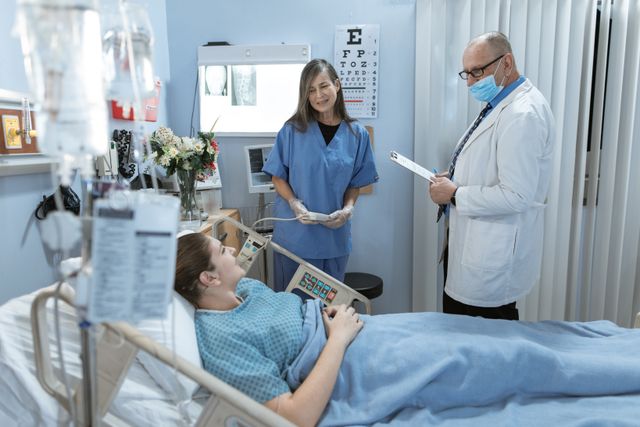
A medical visit involves more than describing symptoms. You may need to book an appointment, explain why you are there, answer questions at reception, provide insurance information, or ask the doctor to repeat instructions.
Learning a few phrases for those practical stages can make the whole experience much easier.
Booking and Arriving for a Medical Appointment in France
Appointments with doctors in France may be arranged by phone, directly through a medical practice, or through an online booking platform. Depending on the type of doctor and your situation, you may also need a referral.
Useful phrases include:
- Je voudrais prendre rendez-vous avec un médecin. – I’d like to make an appointment with a doctor.
- Je voudrais prendre rendez-vous avec le docteur Martin. – I’d like to make an appointment with Dr Martin.
- Avez-vous un rendez-vous disponible aujourd’hui ? – Do you have an appointment available today?
- C’est urgent. – It’s urgent.
- J’ai rendez-vous à quinze heures. – I have an appointment at 3 p.m.
- Je suis ici pour mon rendez-vous. – I’m here for my appointment.
- Voici ma carte Vitale. – Here is my Carte Vitale.
- Voici ma carte européenne d’assurance maladie. – Here is my European Health Insurance Card.
- J’ai une assurance voyage. – I have travel insurance.
- Je n’ai pas de carte Vitale. – I don’t have a Carte Vitale.
- Est-ce que je dois payer maintenant ? – Do I need to pay now?
Reception staff may ask:
- Vous avez votre carte Vitale ? – Do you have your Carte Vitale?
- Vous avez une mutuelle ? – Do you have complementary insurance?
- Vous avez rendez-vous ? – Do you have an appointment?
- Quel est votre nom ? – What is your name?
- Quelle est votre date de naissance ? – What is your date of birth?
If you do not understand, a simple Pardon, pouvez-vous répéter plus lentement ? [Sorry, could you repeat more slowly?] is perfectly appropriate.
Useful Phrases for Talking to a Doctor in French
Once the consultation begins, short and direct sentences are usually best.
| English | French |
| I need a doctor. | J’ai besoin d’un médecin. |
| I need a prescription. | J’ai besoin d’une ordonnance. |
| I’m allergic to penicillin. | Je suis allergique à la pénicilline. |
| I’m taking these medicines. | Je prends ces médicaments. |
| I started feeling ill yesterday. | J’ai commencé à me sentir mal hier. |
| The pain started this morning. | La douleur a commencé ce matin. |
| It hurts here. | J’ai mal ici. |
| I feel worse. | Je me sens plus mal. |
| Is it serious? | Est-ce que c’est grave ? |
| Do I need tests? | Est-ce que je dois faire des examens ? |
| Do I need a prescription? | Est-ce qu’il me faut une ordonnance ? |
| How often should I take this? | Combien de fois par jour dois-je le prendre ? |
| For how many days? | Pendant combien de jours ? |
| When should I come back? | Quand est-ce que je dois revenir ? |
| Can you write that down? | Vous pouvez l’écrire, s’il vous plaît ? |
A few additional expressions can be especially helpful when the conversation becomes difficult:
- Je ne comprends pas. – I don’t understand.
- Pouvez-vous parler plus lentement ? – Can you speak more slowly?
- Pouvez-vous répéter ? – Can you repeat that?
- Comment est-ce que je dois prendre ce médicament ? – How should I take this medicine?
- Est-ce que je peux le prendre avec mes autres médicaments ? – Can I take it with my other medicines?
- Est-ce qu’il y a des effets secondaires ? – Are there any side effects?
Questions a French Doctor May Ask You
Understanding the doctor is just as important as knowing what to say yourself. Some common questions include:
- Où avez-vous mal ? – Where does it hurt?
- Depuis quand avez-vous mal ? – How long have you been in pain?
- Depuis quand avez-vous ces symptômes ? – How long have you had these symptoms?
- Vous avez de la fièvre ? – Do you have a fever?
- Vous prenez des médicaments ? – Are you taking any medication?
- Vous avez des allergies ? – Do you have any allergies?
- Vous avez déjà eu ce problème ? – Have you had this problem before?
- Vous êtes enceinte ? – Are you pregnant?
- Vous fumez ? – Do you smoke?
- Vous avez des antécédents médicaux ? – Do you have any relevant medical history?
You do not need to answer with long sentences. Oui, non, depuis trois jours [for three days], or seulement le soir [only in the evening] may be enough.
French Medical Vocabulary You May Hear During an Examination
Doctors and nurses may use words that are less common in everyday conversation but appear frequently during appointments.
- examen – examination / test
- prise de sang – blood test
- tension – blood pressure
- température – temperature
- radio / radiographie – X-ray
- échographie – ultrasound
- scanner – CT scan
- IRM – MRI
- analyse – test / analysis
- résultats – results
- ordonnance – prescription
- traitement – treatment
- dose – dose
- effets secondaires – side effects
For example:
On va prendre votre tension.
[We’re going to take your blood pressure.]
Je vais vous prescrire une prise de sang.
[I’m going to prescribe/order a blood test.]
Il faudra faire une radio.
[You’ll need to have an X-ray.]
Je vais vous faire une ordonnance.
[I’m going to write you a prescription.]
What Should You Expect from a Medical Appointment in France?
Medical interactions in France are generally polite but relatively direct. You will normally begin with Bonjour, and using vous with doctors, nurses, pharmacists, and reception staff is the safest default unless they indicate otherwise.
You may address a doctor as Docteur, particularly when speaking directly to them: Merci, docteur [Thank you, doctor]. However, ordinary polite language with vous is usually more important than repeatedly using a title.
Consultations can also feel fairly matter-of-fact. A doctor may move quickly through questions about symptoms, medication, medical history, and duration before examining you. That directness should not necessarily be interpreted as coldness; it is simply part of the practical rhythm of many medical appointments.
Why “Vous” Is the Safest Choice in French Healthcare
Medical settings are one of the clearest situations in which vous is the appropriate default. Even if the doctor is young or the consultation feels friendly, vous maintains the professional relationship and avoids unnecessary familiarity.
For example:
- Pouvez-vous répéter ? – Can you repeat that?
- Qu’est-ce que vous me conseillez ? – What do you recommend?
- Est-ce que vous pouvez m’expliquer ? – Can you explain it to me?
- Vous pouvez l’écrire, s’il vous plaît ? – Can you write it down, please?
A healthcare professional will normally use vous with an adult patient as well. If they use tu in a particular context, you can simply follow their lead.
How to Ask for Clarification in French Without Feeling Rude
Medical French can become difficult very quickly, even for learners who manage ordinary conversations comfortably. Doctors may use unfamiliar vocabulary, speak quickly, or explain several instructions at once.
It is completely appropriate to interrupt politely and ask for clarification.
Useful phrases include:
- Excusez-moi, je n’ai pas compris. – Excuse me, I didn’t understand.
- Pouvez-vous répéter, s’il vous plaît ? – Could you repeat that, please?
- Pouvez-vous parler un peu plus lentement ? – Could you speak a little more slowly?
- Qu’est-ce que ça veut dire ? – What does that mean?
- Vous pouvez me l’écrire ? – Can you write it down for me?
- Est-ce que vous pouvez expliquer plus simplement ? – Could you explain it more simply?
Asking the doctor to write down the name of a medicine, test, or diagnosis can be especially useful. Medical vocabulary is difficult to recognise by sound alone, and having the word in writing makes it easier to check instructions later or communicate with a pharmacist.
What Should You Say in a Medical Emergency in France?
A medical emergency is stressful anywhere, but dealing with one in another language can make the situation much harder. In France, it helps to know which number to call, how to say that the situation is urgent, and how to describe the problem in a few direct French sentences.
For a medical emergency, 15 connects you to SAMU, France’s emergency medical service. You can also call 112, the European emergency number, which can direct you to the appropriate emergency service. France also uses 18 for the fire and rescue service and 17 for the police. The European number 112 is available throughout the EU, and official French guidance notes that operators can communicate in French or English.
Emergency Numbers to Know in France
The most important numbers to save before travelling to France are:
- 15 – SAMU: medical emergencies
- 112 – European emergency number
- 18 – Pompiers: fire brigade and rescue
- 17 – Police / Gendarmerie: police emergencies
People who are deaf, hard of hearing, deafblind, aphasic, or otherwise unable to communicate by ordinary voice call can also use 114, including by text and supported digital services.
For an immediate medical problem, 15 or 112 is usually the most relevant choice.
Essential French Phrases for a Medical Emergency
In an emergency, short phrases are better than complicated sentences.
- Au secours ! – Help!
- C’est une urgence. – It’s an emergency.
- J’ai besoin d’une ambulance. – I need an ambulance.
- Appelez une ambulance, s’il vous plaît. – Call an ambulance, please.
- Je n’arrive pas à respirer. – I can’t breathe.
- J’ai du mal à respirer. – I’m having difficulty breathing.
- J’ai très mal. – I’m in a lot of pain.
- J’ai mal à la poitrine. – I have chest pain.
- Je crois que je vais m’évanouir. – I think I’m going to faint.
- Il / Elle est inconscient(e). – He / She is unconscious.
- Il y a eu un accident. – There has been an accident.
- Il / Elle saigne beaucoup. – He / She is bleeding heavily.
- Où sont les urgences les plus proches ? – Where is the nearest emergency department?
- Vite, s’il vous plaît. – Quickly, please.
If you are calling emergency services, be prepared to give your location as clearly as possible. You may hear questions such as Où êtes-vous ? [Where are you?], Que s’est-il passé ? [What happened?], or La personne est-elle consciente ? [Is the person conscious?].
What Does “Les Urgences” Mean in France?
In France, les urgences refers to the hospital emergency department. If someone tells you Allez aux urgences [Go to the emergency department], they are telling you to seek hospital emergency care.
You may also see service des urgences on signs inside or outside hospitals.
Not every medical problem requires the emergency department. For a serious or potentially life-threatening problem, calling 15 or 112 allows the emergency service to assess the situation and direct you appropriately. For less urgent problems, a doctor, pharmacy, or out-of-hours medical service may be more suitable.
French Phrases You May Hear from Emergency Services
Understanding a few common questions can help when the situation is already stressful.
- Quelle est l’adresse ? – What is the address?
- Que s’est-il passé ? – What happened?
- La personne respire ? – Is the person breathing?
- La personne est consciente ? – Is the person conscious?
- Quel âge a la personne ? – How old is the person?
- Depuis combien de temps ? – For how long?
- Est-ce qu’elle saigne ? – Is he/she bleeding?
- Restez en ligne. – Stay on the line.
- Ne raccrochez pas. – Don’t hang up.
- Les secours arrivent. – Help is on the way.
You do not need sophisticated French to respond. Giving the address, the person’s age, the main symptom, and simple answers such as oui, non, or je ne sais pas can still provide valuable information.
Useful French Healthcare Resources for Visitors and Expats in France
Learning French medical vocabulary makes it easier to communicate, but language knowledge should support professional healthcare rather than replace it. If you need reliable information about medical care, insurance, or emergency services in France, official French healthcare resources should be your first reference.
Useful resources include:
- Ameli / Assurance Maladie – Official information about the French health insurance system, reimbursement, the Carte Vitale, medical care, and patient rights.
- Service-Public.fr – Official government guidance on emergency numbers, administrative procedures, and public services in France.
- Santé.fr – Public information about healthcare services and health resources in France.
- Your travel or private health insurer – Particularly important for visitors who are not covered by the French public system.
Learn French Medical Vocabulary for Real-Life Situations in France
French medical vocabulary is most useful when you can use it spontaneously under pressure. Memorising J’ai mal à la tête [I have a headache] is a good start, but a real appointment may also require you to explain when the pain began, understand a follow-up question, describe medication you already take, or ask the doctor to repeat an instruction.
That is where personalised language learning can make a significant difference. A native French teacher can help you practise complete situations rather than isolated vocabulary: making an appointment, checking in at reception, describing symptoms, speaking to a pharmacist, or asking what a prescription means.
This is especially useful for learners who need French for a specific professional or personal context. Someone relocating to France may want to understand terms such as Carte Vitale, mutuelle, and médecin traitant, while a traveller may prefer to focus on emergency language, pharmacies, and the phrases most likely to be useful during a short stay.
At Language Trainers, both our face-to-face French courses and live online French lessons are one-to-one and adapted to the learner. Your teacher can focus on the situations, vocabulary, and level of formality that matter to you rather than following a generic set of travel phrases.
Preparing before you need the language can make an unfamiliar situation far easier to manage. Contact Language Trainers today to arrange personalised French lessons and build the practical vocabulary you need for everyday life, work, travel, and healthcare in France.
→Sign Up Now: Free Trial French Lesson With a Native Teacher!←
Frequently Asked Questions About French Medical Vocabulary in France
1. How Do I Ask for Medical Help in French?
The simplest way to ask for medical help in French is to use short, direct phrases such as J’ai besoin d’un médecin [I need a doctor], J’ai besoin d’une ambulance [I need an ambulance], or Je ne me sens pas bien [I don’t feel well]. You can then describe the main symptom with phrases such as J’ai de la fièvre [I have a fever], J’ai mal au ventre [My stomach hurts], or J’ai du mal à respirer [I’m having difficulty breathing].
2. What French Phrases Should I Know Before Seeing a Doctor in France?
Some of the most useful phrases include J’ai mal ici [It hurts here], Depuis trois jours [For three days], Je prends ces médicaments [I take these medicines], Je suis allergique à… [I’m allergic to…], and Pouvez-vous répéter plus lentement ? [Could you repeat more slowly?]. It is also useful to recognise questions such as Où avez-vous mal ? [Where does it hurt?] and Depuis quand ? [Since when?].
3. How Do I Ask for Medicine at a Pharmacy in France?
You can describe your symptom and ask the pharmacist for advice. For example, Vous avez quelque chose pour le mal de tête ? means “Do you have something for a headache?”, while J’ai mal à la gorge. Vous pouvez me conseiller quelque chose ? means “I have a sore throat. Can you recommend something?” If you have a prescription, say J’ai une ordonnance [I have a prescription].
4. What Does “Ordonnance” Mean in French Healthcare?
Une ordonnance is a medical prescription. A doctor may say Je vais vous faire une ordonnance [I’m going to write you a prescription], and you can then take it to a pharmacy. Some medicines in France require an ordonnance, while others can be supplied without one.
5. What Is a Carte Vitale in France?
The Carte Vitale is the health insurance card used by people registered with the French Assurance Maladie system. Healthcare professionals use it to transmit information for reimbursement. It is not itself a private insurance policy and should not be confused with a mutuelle, which is complementary health insurance.
6. What Is the Difference Between “J’ai mal au ventre” and “J’ai mal à l’estomac”?
J’ai mal au ventre means that your abdomen or stomach area hurts and is very common in everyday French. J’ai mal à l’estomac refers more specifically to the stomach itself. If you are unsure exactly where the problem is, J’ai mal au ventre will often sound more natural.
7. What Does “J’ai mal au cœur” Mean in French?
Despite the literal wording, J’ai mal au cœur usually means “I feel nauseous” rather than “My heart hurts.” If you have chest pain, say J’ai mal à la poitrine [I have chest pain] and seek appropriate medical attention, especially if the symptom is severe or sudden.
8. What Number Should I Call for a Medical Emergency in France?
For a medical emergency in France, call 15 for SAMU or 112, the European emergency number. France also uses 18 for the fire and rescue service and 17 for police emergencies. The 112 service can direct callers to the appropriate emergency service.